


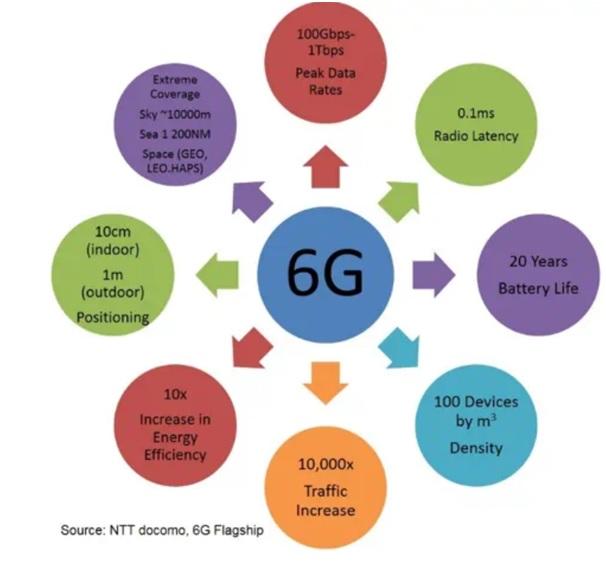
The 6G Market is forming now through research funding, prototype development, and early ecosystem partnerships. Unlike mature telecom markets, 6G commercialization will follow a long runway that includes standards definition, spectrum allocation, infrastructure readiness, and device availability. Market growth initially centers on R&D spending by governments, universities, and major telecom vendors, followed by trials led by operators and industrial partners. As with earlier generations, the market will include radio access equipment, core network software, semiconductors, test and measurement tools, and services. However, 6G may broaden the value chain by integrating sensing, edge compute, and AI-native network orchestration as core components. The strength of early alliances—between operators, cloud providers, chipset makers, and vertical industries—will strongly influence how quickly the market moves from research to deployable solutions.
Key market drivers include the need for higher capacity, improved reliability, and better support for automation-heavy industries. Data growth from video, connected devices, and AI workloads strains networks, especially in dense urban environments and high-traffic venues. Enterprises also demand deterministic performance for robotics, inspection, and mission-critical operations, which pushes innovation in latency and reliability. Another driver is non-terrestrial integration, expanding coverage through satellites and aerial platforms for remote regions and disaster recovery. Governments view 6G as strategic infrastructure, which can accelerate funding and policy support. On the supply side, competition in patents, chip manufacturing, and network equipment motivates early investment. Yet the market will remain sensitive to macroeconomic conditions, operator capex cycles, and the perceived ROI of upgrading beyond 5G and 5G-Advanced.
The market’s structure will likely evolve through phases. Early phases prioritize research platforms, channel modeling, spectrum experiments, and proof-of-concept networks. Later, pre-commercial pilots test interoperability, security frameworks, and energy efficiency at scale. Vendors will compete on AI-driven management, advanced radios, and integrated sensing capabilities. Cloud and edge providers may gain influence because software-defined networks and compute integration are central to 6G’s promise. Standards and regulation will shape vendor strategies, particularly around spectrum harmonization and security requirements. Talent and supply chain capacity also matter, since advanced RF engineering, semiconductor processes, and systems integration are scarce. The market will reward players that can translate research into reliable products that operators can deploy and maintain economically.
Long-term market expansion depends on creating compelling services and business models. If 6G only offers incremental speed improvements, adoption may be slower. Stronger growth occurs if operators can monetize enterprise-grade services, sensing-based offerings, and guaranteed performance slices. Device ecosystems must also mature, including affordable chipsets, power-efficient radios, and integrated antenna designs. Sustainability constraints may push innovation in energy-aware networks and greener hardware. As deployments approach, competitive dynamics will intensify around interoperability, security assurance, and total cost of ownership. The 6G market’s trajectory will therefore be driven by a mix of technology readiness, regulatory alignment, and whether new applications justify the next generational shift.
Top Trending Reports:

 English
 Arabic
 French
 Spanish
 Portuguese
 Turkish
 Dutch
Dutch
 Italiano
 Russian
 Romaian
 Portuguese (Brazil)
 Tiếng Việt